AI Ethics Policy
November 7, 2025
Scope: Product “Supercount AI”
Version: 1.0
1. Preamble
Supercount AI develops technologies according to the principle of Digital Humanism. We do not view generative artificial intelligence as a replacement for human expertise, but as a powerful assistance system. Our basic stance is: Technology serves mankind, responsibility remains with the expert.
2. Our 5 Fundamental Principles for Trustworthy AI
2.1 Human-in-the-Loop & Human Final Decision
Our system is a probabilistic tool for knowledgeable users. It generates suggestions but never makes autonomous tax or accounting decisions.
Policy: Every LLM-based proposal (e.g., booking entry approval) requires a review including mandatory confirmation by a qualified user.
Declaration on Risk Classification according to the EU AI Act: Supercount AI was developed with the regulatory aim that it is classified as a system with limited risk (not a high-risk system) according to the classification of the EU AI Act. The system serves to optimize processes in commercial accounting (B2B) and does not make assessments that could affect access to essential private or public services, the creditworthiness of individuals, or the evaluation of employees, or fall into other high-risk areas. Due to the use of generative AI models, we are therefore subject to the transparency obligations pursuant to Art. 50 EU AI Act. We fulfill these technically and organizationally by ensuring that AI-generated suggestions are clearly identifiable as such in the interface and are not further processed without human confirmation.
2.2 Data Sovereignty & Privacy
The professional secrecy of our clients is an incremental component of our business activities.
Policy: Training of our AI models with customer-specific data is categorically excluded. Customer data is processed exclusively through RAG (Retrieval-Augmented Generation) in the context of the respective session and strictly isolated. Hosting is performed exclusively in EU data centers in compliance with GDPR.
2.3 Transparency & Explainability
Users need to understand that they are interacting with an AI and how results are generated.
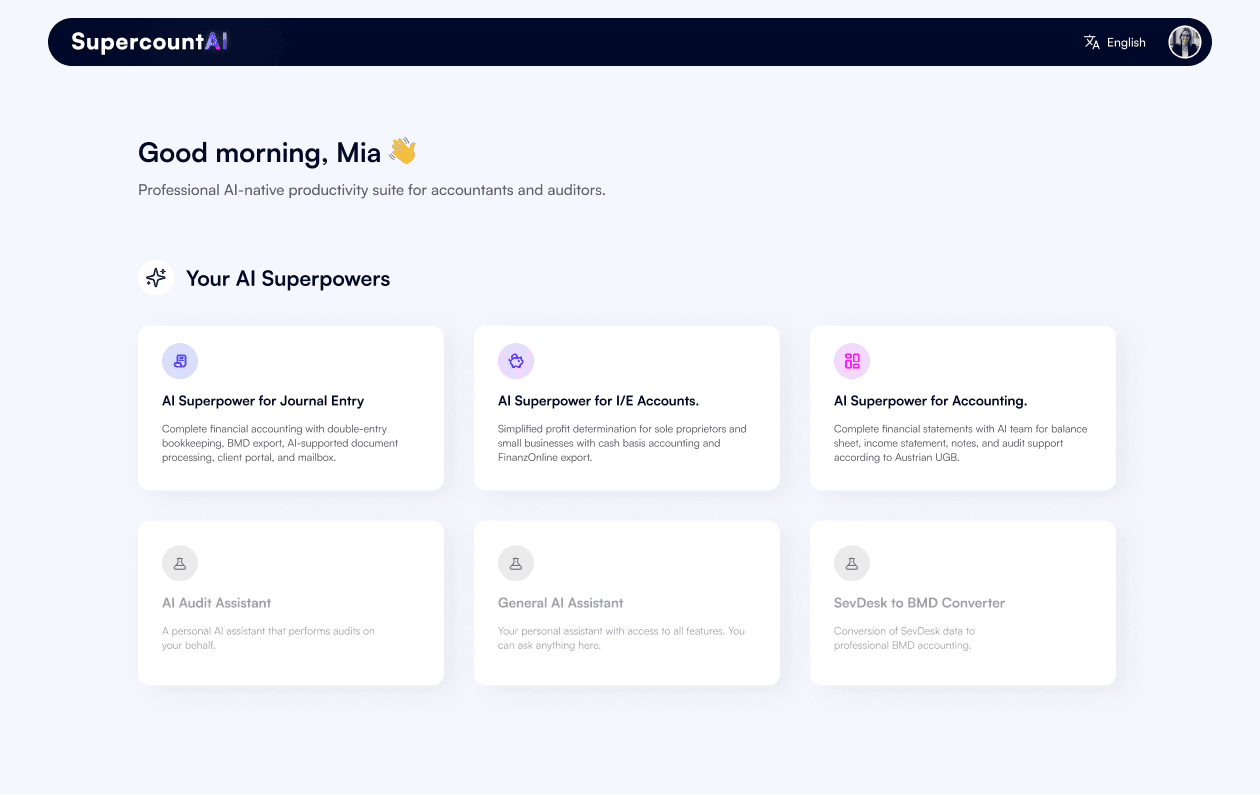
Policy: AI-generated content is visually highlighted in the user interface. The derivation (e.g., extraction from document image) is transparently displayed to enable validation by humans. Furthermore, a so-called AI justification is provided, explaining how the LLM-based system reached the conclusion.
2.4 Avoidance of Bias & Discrimination
Bias can also occur in accounting (e.g., in the categorization of certain suppliers).
Policy: We mitigate bias and discrimination risks with targeted guardrails in system instruction development. We test our models against test datasets during significant updates to ensure the most objective processing possible, in line with the expected technology standard.
2.5 Technical Robustness
The system must remain stable even in the case of erroneous inputs.
Policy: In the development of system instructions, we rely on plausibility checks that, for example, identify unsuitable documents as such and automatically flag them for renewed human review.
3. Declaration of Commitment
The management of Supercount AI FlexCo commits to comply with these guidelines and reviews their relevance at least annually or upon significant model updates (e.g., change of LLM generation).